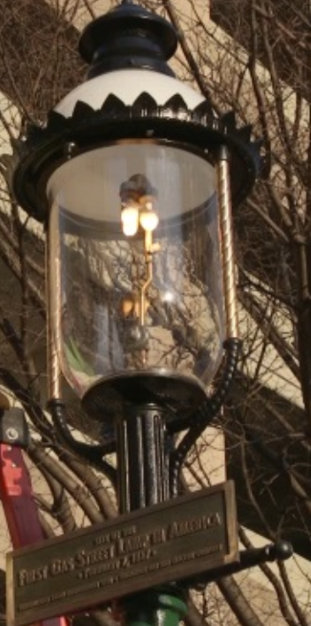
On February 5, 1817, the Gas Light Company of Baltimore was officially chartered, becoming the first commercial gas-lighting utility in the United States. Using manufactured gas produced from coal, the company introduced city-scale energy distribution at a time when streets and buildings were still lit by candles, whale oil, and kerosene lamps. Baltimore quickly became a testing ground for what centralized urban energy could look like.
Within a few years, gas lamps were illuminating public streets, businesses, and theaters, extending productive hours after sunset and improving public safety. By the 1820s, Baltimore's success inspired similar gas utilities in cities like New York, Boston, and Philadelphia, accelerating the spread of underground gas mains and metered energy use. By mid-century, manufactured gas systems were serving hundreds of thousands of customers across the U.S., decades before electricity entered daily life.
This early gas infrastructure laid the foundation for today's natural-gas industry. Techniques developed for coal-gas production, storage, pipelines, and billing later transitioned smoothly into natural gas distribution after major gas discoveries in the late 1800s. What began as street lighting in one city ultimately shaped how modern energy networks are built, regulated, and scaled nationwide.